






RUDN Journal of Philosophy
Editor-in-Chief: Vladimir N. Belov, D.Sc. in Philosophy, Professor
ISSN: 2313-2302 (Print) ISSN: 2408-8900 (Online)
Founded in 1997. Publication frequency: quarterly.
Open Access: Open Access . APC: no article processing charge.
Peer-Review: double blind. Publication language: Russian, English
Journal History
PUBLISHER: Peoples’ Friendship University of Russia named after Patrice Lumumba (RUDN University)
Indexation: White List of RCSI, RSCI, Scopus, Russian Index of Science Citation, Google Scholar, Ulrich's Periodicals Directory, Dimensions, DOAJ
"RUDN Journal of Philosophy” a peer-reviewed academic journal. For many years, the journal has been a space to feature the best research of the leading Russian and international scholars in the fields of History of Philosophy, Ontology, Theory of Knowledge, Social Philosophy, Religious Studies and other areas. Our editorial policy also involves a strong support of young talented scientists throughout the world. The unique experience and traditions of the school of philosophical thought of RUDN University are embodied in philosophical comparativism, which is the top-priority research area of the journal.
Announcements More Announcements...
Call for papers: Special themes in 2027Posted: 14.09.2026
Special theme of the 1st issue 2027: “The Philosophy of Heinrich Rickert” Special theme of the 2nd issue 2027: “Modern problems of ethical thought” Special theme of the 3rd issue 2027: “Martin Heidegger's Magnum Opus 'Being and Time': Meanings, Interpretations, Reception” Special theme of the 4th issue 2027: “Justice in a Changing World: Philosophical Aspects” |
|
|
Call for papers: Special themes in 2026Posted: 02.12.2025
Special theme of the 1st issue 2026: “The History of Russian Philosophy in China” Special theme of the 2nd issue 2026: “Muslim Philosophy and Contemporary Situation: Interruption or Revival with New Interpretations of an Intellectual Tradition in the Post-Metaphysical, Post-Modern and Post-Truth Era” Special theme of the 3rd issue 2026: “The Philosophy of Ernst Cassirer” Special theme of the 4th issue 2026: “Philosophical problems of Artificial Intelligence” |
|
|
Current Issue
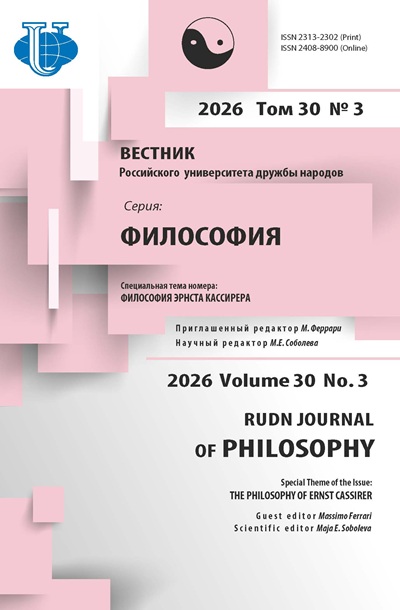
Vol 30, No 3 (2026): THE PHILOSOPHY OF ERNST CASSIRER
- Year: 2026
- Articles: 26
- URL: https://journals.rudn.ru/philosophy/issue/view/2182
- DOI: https://doi.org/10.22363/2313-2302-2026-30-3
Full Issue

THE PHILOSOPHY OF ERNST CASSIRER
Ernst Cassirer’s Philosophy in the Context of the Cultural Turn
Abstract
The research serves as an introduction to Cassirer’s philosophy of symbolic forms from the perspective of the so-called “cultural turn” in the methodology of science. Although Cassirer viewed his system as “prolegomena” to a future philosophy of culture and can therefore be regarded as a harbinger of the processes that took place in the late twentieth-century sciences, his philosophy, due to historical circumstances, did not exert a significant influence on their development. However, it has become widely sought after precisely because of these very changes. The study discusses the factors that have accounted for the “renaissance” of Cassirer’s theory since the early 1990s. The author then points to problematic areas in the philosophical study of the system of symbolic forms. Three aspects are particularly highlighted: the extent to which Cassirer’s approach to understanding culture is “Kantian”; the methodological status of symbolic forms, in particular, what is meant by their a priori character; and whether Cassirer’s philosophy of culture is idealistic, or whether his constructivism can be viewed as a form of realism. These aspects already indicate that Cassirer's theory still holds considerable potential for reflection and possible further development. Some approaches to working with Cassirer’s theoretical legacy are presented in the research. Overall, this paper is introductory in nature and is intended as an opening to this issue, which is devoted to an analysis of the philosophy of one of the significant thinkers of the 20th century.
 719-729


Ernst Cassirer and the Never-Ending Story of the Problem of Knowledge
Abstract
Building on and following Ernst Cassirer’s monumental treatise on the problem of knowledge in modern philosophy and science, this research explores the relationship between philosophy, knowledge, and history. Its starting point is the definition of philosophy as the critical self-understanding of the process of knowledge. This starting point is appropriate because philosophers grapple with the substantive core of the “miracle of knowledge” by accusing one another of failing to recognize this core, or at least of failing to recognize it with sufficient clarity. However, they must justify their accusations and are thus led to the question of how the claim to valid knowledge of this very core can be justifiably asserted. In this respect, modern philosophy is characterized less by its discovery than by an awareness of the historicity of the starting points of its inquiry. Against this backdrop, Cassirer presents history as the idea of a meaningful succession of events in time. Thus, “knowledge” becomes the logical subject of the history of its theories. They “reveal” the “miracle of knowledge” by embodying the forms that enable the fundamental problem of its revelation to be reformulated anew time and again. History thus signifies not the subjective process of cognition, but the objective progression of knowledge - documented in the increasing differentiation of the sciences - with regard to the content and scope of its claim to validity. This changes the character of philosophy as a whole: its task is no longer to point out problems to science, but to structure the unity of knowledge in the foundations of its symbolic forms. To put it more pointedly: through its critical self-understanding, modern philosophy expands the philosophy of knowledge into a general critique of culture.
730-743
Ernst Cassirer's Basic Phenomena and the Limits of the Transcendental Method
Abstract
The study demonstrates that Ernst Cassirer’s philosophy of symbolic forms remains within the horizon of the Neo-Kantian objectivism of validity, which in the Marburg school of Neo-Kantianism follows - under the heading of the “transcendental method” - the “regressive mode of teaching” or “analytic method” of Kant’s Prolegomena , which proceeds from a given fact and advances from there to the underlying principles. However, in attempting to liberate the “transcendental method” from its restriction to the factum of mathematical natural science and to extend it to the factum of the cultural sciences, Cassirer’s work clearly reveals the systematic problems that Neo-Kantianism believed it could overcome through its factum-theorem. The restriction of the transcendental method to the regressive mode of teaching of the Prolegomena and to mathematical natural science is paradigmatically found in Cassirer’s early work Substance and Function . His critique of the concept of substance and of the psychologistic theory of abstraction forms the starting point for his later extension of the “transcendental method” and will therefore be examined at the outset. From the perspective of the demand for a “logic of objective knowledge”, as Cassirer formulates it in his essay Kant and Modern Mathematics , the transition to the program of the philosophy of symbolic forms will then be made comprehensible, and the relationship of the symbolic forms to the required transcendental logic will be examined. Since, however, the problem of a “logic of objective knowledge” remains unresolved on the ground of the philosophy of symbolic forms, Cassirer finds himself - following his systematic main work - faced with the alternative of spirit or life, from which accordingly his preparatory works for the planned fourth volume of the symbolic forms also proceed. Finally, the study will examine to what extent these preparatory works - which remained fragments - toward a theory of “basic phenomena” succeed in overcoming the opposition between spirit and life, between Kantianism and Goetheanism, and what is actually to be understood by this opposition.
744-765
E. Cassirer’s Transcendental Project: The Metaphysics of Scientific Experience
Abstract
The aim of the research is to reconstruct transcendental project of E. Cassirer, his metaphysics of scientific experience. To this end, the study first provides a brief outline of Kant’s transcendental philosophy (transcendentalism), then discusses the Neo-Kantian version of transcendentalism, i.e., Neo-Kantian modifications of the concept of experience and a priori (primarily in the person of H. Cohen (see his “Kant’s Theory of Experience”), and describes Cohen’s genetic concept of cognition. Then a reconstruction (explication) of Cassirer’s own version of transcendentalism is given and two of his main “transcendental” innovations are analyzed: the theory of [a priori] invariants and the “functional” doctrine of a thing (substance vs. function). Analysis of the latter shows that the “functional” doctrine of a thing (in its various modifications), on the one hand, is a development of Kant’s doctrine of the transcendental object, and, on the other hand, it is a precursor and one of the variants of modern structuralism (structural realism).
766-781
Ernst Cassirer’s Critique of (Political) Myth
Abstract
The study revisits the Second Volume of the Philosophy of Symbolic Forms published in 1925. Under the title “Mythical Thinking”, Ernst Cassirer examines myth as a symbolic form; through an analysis that is at once historical and systematic, he paves the way for an expansion of the term’s scope - a shift that becomes increasingly evident in his later treatises. By the concept of myth, he refers no longer exclusively to the “grand narrative” but also, pars pro toto, to “mythical consciousness”, “mythical thinking”, and a “mythical form of life”; in doing so, he points neither to a merely archaic stage of cultural development nor simply to one cultural sphere among others. Significant - and demanding serious attention - is his metaphorical description of myth as the “native soil” (Mutterboden) of culture. This metaphor vividly reinforces a claim Cassirer maintained consistently until the very end: that myth retains its relevance even within modern culture. A clear instance of this ongoing relevance is found in his critique of the intellectual-historical elements underpinning totalitarian rule - an analysis he presents with regard to the National Socialist regime in his final completed work, “The Myth of the State”. This poses a considerable challenge to our former understanding, informed by his philosophy of culture: Is the concept of myth invoked in the phrase “the myth of the state” truly the same as the one with which he had previously familiarized readers of his writings on mythical thought? Cassirer’s earlier hints to the possibility of cultural conflicts - indeed, as he calls them “antinomies of culture” - find a concrete illustration, an exemplification in “The Myth of the State”.
782-798
Myth and Symbolic Conciseness: From the Symbolic Forms of Ernst Cassirer to the Acoustemology of Steven Field
Abstract
This short essay on Myth and symbolic Pregnancy presents a comparison between Cassirer and Feld, exploring themes that are complementary - despite originating from disciplines with markedly different scientific frameworks. The work is organized into three sections: a) The first section examines the concept of myth and its mythical dimension from Cassirer’s perspective. It highlights the most distinctive features of myth and his philosophical architecture. Concluding this part, the notion of “symbolic pregnancy” is introduced as the fundamental dynamic driving the symbolic process; b) The second section approaches “symbolic pregnancy” as the beating heart of acustemology - one of the most recent neologisms in epistemology. It reflects on the techniques of symbolic pregnancy and their characteristics within a specific cultural context; c) The analysis then shifts to explore the “linguistic game” determined by the dynamics of symbolic pregnancy. Here, the perspective adopts a universal view, in line with the symbolic process. At the core of this work lies a fundamental philosophical question emphasized by Cassirer concerning the separation - within the mythical dimension - of language and thought.
799-814
Ernst Cassirer’s Symbolic Construction: The Mythological Chronotope
Abstract
The purpose of this study is to explore the symbolic construction of myth in Ernst Cassirer’s “Philosophy of Symbolic Forms”. This study provides insight into the new understanding of myth in contemporary culture. A comparative analysis of early 20th-century studies on mythological thinking reveals that the new understanding of myth revolves around the mythologem of the beginning. The relevance of studying mythological chronotopes lies in the need to organize the fundamental concepts and principles of myth-making, as well as to explain the meaning and historical boundaries of this phenomenon. In The Philosophy of Symbolic Forms, Cassirer applied the theory of symbolic representation to culture, particularly to myth. The subject of study (culture) is placed within the symbolic activity of consciousness. The symbol builds its content from the active principle of the spirit (Ursprung). Instead, Cassirer focuses on the algorithm for transforming subjective affects into the sensory existence of myth. The “difference” in the series of everyday repetitive meanings is the power of Man. The subject feels this power and submits to it. The symbolic construction of consciousness projects the object into a different, sacred realm. This is how the symbolic series of repetitive sacred images is formed. This is a mythological chronotope, at the center of which is a sacred source. The study reveals that the mythological symbol forms a special experience of the interaction between the sacred and the profane. It is both connected to and free from sensory perception. The myth becomes a symbolic form and an active constructing principle. This principle ensures the autonomy of the myth and structures the chaos of impressions through the image-sign, which refers to the origins in ritual actions. The purpose of Cassirer's symbolic construction of myth is not cognition, but the organization of behavior.
815-830
Ernst Cassirer: On the Foundations of (Social)political Behavior. A Contribution to the Philosophy of Symbolic Forms. The Arts
Abstract
A central concern in Cassirer’s writings is to shed light on the living process of culture. According to the thesis of this article, by exploring the conditions of this process, Cassirer simultaneously laid the foundation for (socio-)political behaviour. This is possible only through the arts. The article thus contributes to Cassirer’s planned but never written volume on the Philosophy of Symbolic Forms. The Arts. A prerequisite for this - something Cassirer ruled out, but that can be confirmed in line with life sciences - is that the arts, just like mathematics and biology, are based on universal laws and logic. It is the primordial phenomenon of perception of expression which Cassirer identified as central to (historical) dialectics, that also controls the processing of non-discursive living forms for dialogue. It concerns mythical thinking and aesthetic visual and linguistic awareness, but not scientific-theoretical reflection. Its process logic forms the basis of mental images and actions that determine behaviour within societies. However, the behaviour mediated by the creative-symbolic modes of forms is not neutral; it is driven by the motivation to unite with others in a society. Contrary to Cassirer´s assumption, this need is not limited to communities dominated by myth. This “deep and burning longing” does, however, have consequences for behaviour within communities; in the pursuit of security, it determines whether someone is welcomed (friendly) or excluded (to the point of racism). Ultimately, the freedom to fulfil this need lies solely within the self as the “I”.
831-850
Cosmos as a Symbolic Form: Ernst Cassirer’s Philosophy of Space and the Ethics of Space Exploration
Abstract
Contemporary debates on space expansion call for a new understanding of this issue. Existing normative approaches were developed in relation to the needs of human life on Earth. Their direct transfer to extraterrestrial environments remains methodologically and ethically problematic. This gap determines the relevance of the present study, which grounds a philosophical approach capable of understanding outer space simultaneously in its scientific, mythical, aesthetic, ethical, and other dimensions without reducing it to any one of them. The aim of the study is to provide an explicit and systematic reconstruction of Ernst Cassirer’s philosophy of symbolic forms and to develop, on this basis, an ethics of cosmic responsibility. The research draws upon Cassirer’s major works and contemporary studies in space ethics. The methodology follows Cassirer’s transcendental analysis of space, symbolic form, and the concept of animal symbolicum , reconstructing these concepts in their internal logic and critically applying them to space ethics. The findings show that Cassirer’s conception of space allows outer space to be understood as a multidimensional symbolic reality rather than a value-neutral domain. The concept of animal symbolicum mitigates the risk of identity loss, since human identity depends on the capacity for symbolic activity rather than on the place of habitation, even in extraterrestrial environments. Any space inhabited by humans constitutes a symbolic form through which values are legitimized by different cultural forms. The author argues that cosmic responsibility arises from the very act of symbolic constitution, which attributes values and possesses both constructive and destructive potential. The study concludes that Cassirer’s philosophy contains an underappreciated methodological resource for space ethics. Its novelty lies in deriving responsibility from the theory of symbolic world-formation rather than adapting existing ethical principles to outer space, while preserving conceptual rigor without relying on existential or ontological presuppositions.
851-864
Artificial Intelligence in the Horizon of Symbolic Forms of E. Cassirer
Abstract
The relevance of the study is determined by the transformation of symbolic experience under the conditions of the development of artificial intelligence, accompanied by changes in the mechanisms of meaning-making, interpretation, and the structuring of reality. The aim of the study is to clarify the status of artificial intelligence within Ernst Cassirer’s system of symbolic forms and to identify the conditions for its interpretation as a specific mode of algorithmic symbolization. The theoretical and methodological framework is based on Cassirer’s philosophy of symbolic forms, contemporary concepts of generative reality and digital ontology, as well as critical approaches to modern models of artificial intelligence. The study employs methods of conceptual analysis, comparative-philosophical interpretation, and the analysis of digital practices. The findings demonstrate that artificial intelligence exhibits a partial correspondence to the criteria of a symbolic form, implementing the functions of symbolic mediation, productivity, and limited normative regulation. At the same time, a fundamental distinction is identified between symbolic cognition and algorithmic processing, manifested in the absence of the capacity to generate autonomous normative foundations and to be embedded within a historical and cultural context. It is shown that generative systems reproduce the structural characteristics of the symbolic at the level of probabilistic correlations, without ensuring a coherent unity of meaning. Particular attention is given to the comparison of algorithmic generation with mythological thinking within the framework of Ernst Cassirer’s philosophy of symbolic forms, which makes it possible to clarify the limits of algorithmic symbolization in artificial intelligence and to reveal the difference between the symbolic unity of experience characteristic of myth and the statistical aggregation of sign structures inherent in generative systems. It is argued that artificial intelligence should be understood as a limiting case of algorithmic symbolization and as a specific mode of simulation of the symbolic. The author’s contribution lies in integrating Cassirer’s theory of symbolic forms with the concept of generative reality and contemporary critiques of the limitations of deep learning. This integration makes it possible to specify the limits of the expansion of the symbolic under conditions of algorithmic mediation of culture and to propose a philosophically grounded distinction between symbolic consciousness and the technical reproduction of sign structures.
865-879
Ernst Cassirer’s «An Essay on Man» in the Context of the Anthropological Turn: the Animal Umwelt and the Human World
Abstract
The research presents a comparative analysis of the philosophical interpretations of the concepts of the animal world (Umwelt) and the human world developed in Ernst Cassirer’s “An Essay on Man: An Introduction to a Philosophy of Human Culture” and in the works of Max Scheler, Helmuth Plessner, and Arnold Gehlen. The purpose of this comparison is not only to reveal the specificity of Cassirer’s approach, but also to demonstrate the similarities in their lines of argumentation. In this way, the philosophical-anthropological meaning of Cassirer’s work is clarified, and the work itself is considered within the context of the anthropological turn. It is shown that all the aforementioned theorists referred to the conception of the animal Umwelt developed in the works of Jakob von Uexküll, who demonstrated that the animal and its environment exist in a special dynamic interaction revealing a complex of meanings constituted by the species-specific character of the living being. It is noted that Cassirer not only emphasizes this relation between the animal and its environment, but also draws attention to the fundamental difference between human symbolic activity and the formation of meanings within the animal world. Representatives of the anthropological turn understand the human world as the result of a specific human activity that creates a new reality in which myth and religion, art, science, and history interact in unity. The distinctive character of this activity is clarified through different conceptions of the human being: Cassirer interprets the human functionally, whereas Scheler, Plessner, and Gehlen adopt an essentialist understanding. It is further emphasized that only Gehlen consistently follows a biophilosophical approach, while the other theorists do not ground the phenomenon of human culture-forming activity in the organic constitution of the human being. The study concludes by highlighting the methodological potential of Cassirer’s approach for contemporary philosophical-anthropological research.
880-897
The Function of the Concept of Function, or How not to Defend Cassirer Against Hegel
Abstract
Recently, Hernan Pringe attempted to take up the cudgels for Cassirer’s concept of function. As Krijnen shows, Pringe does not take into account Hegel’s arguments against Cassirer’s conception but merely presents Cassirer’s conception of the function-concept. Against this background, Krijnen brings Hegel's arguments into play. He substantiates his claim that with the Neo-Kantian concept of the concept, as it is paradigmatically constructed by Cassirer as a functional concept, determinacy is conceived of as mediation, not as self-mediation. Consequently, for reasons of principle, Neo-Kantianism does not sufficiently correspond to the claim of transcendental idealism to be self-knowledge of reason.
898-913
Ernst Cassirer - a Philosopher out of his Time
Abstract
The research examines Ernst Cassirer’s major work, The Philosophy of Symbolic Forms, in the context of the changing epistemological landscape, from the early 20th century to the turn of the 21st. The study demonstrates that Cassirer's evolutionary model, which conceptualized changes in human knowledge about the world around us and ourselves, was largely at odds with the philosophical trends that emerged in the late 19th and first third of the 20th centuries (phenomenology, existentialism, analytical philosophy, and others), which developed outside the realm of evolutionary thought. Cassirer's evolutionary model also clashed with the latest trends in many natural and human sciences of the first half of the 20th century (linguistics, ethnography, cosmology). This context proved highly unfavorable for the assimilation and development of the ideas in Cassirer's trilogy within philosophical and scientific thought, as they seemed outdated to contemporaries even by the time of their publication. The decades surrounding the mid-20th century made the idea of evolutionism, and consequently Cassirer's concept, even more unattractive. However, as this research demonstrates, since the second half of the 20th century - in both the natural sciences and the humanities - the ideas of the “Philosophy of Symbolic Forms” examined from a new epistemological perspective, can be useful for better understanding the development of the physical and mathematical sciences, as well as for modern theories of the evolution of consciousness and theories of anthropogenesis. Furthermore, the research suggests that attitudes toward various theories of historical evolution are often linked less to the scientific credibility of a given concept than to how its emergence relates to the overall historical and cultural context. The critical attitude towards many theories of this type, including Cassirer's philosophical concept, was largely due to a distrust of the very idea of progress that engulfed both philosophy and many scientific disciplines, which was probably connected with the political and cultural upheavals that swept Europe in the 1920s and 1930s.
914-930
Philosophy of Ernst Cassirer within the Framework of Intellectual Culture Development
Abstract
In spite of the fact that Ernst Cassirer’s theory is often mentioned in various scientific investigations, its methodologic capabilities - to construct a holistic approach to interpretation of the universal unity of diverse (and incongruous among other things) scientific methods and of heterogeneous forms of life at varying levels of generality - seem to remain underappreciated. The research undertakes to explore the actualization potential of his methodology in light of modern scientific conceptions. The thinker himself engaged with Kant’s doctrine precisely thus, regarding it as a transcendental method bearing transhistorical significance notwithstanding the limitations of its specific findings by the science contemporary to Kant. To this end, the author examines how the methodological foundation of Cassirer’s philosophy is grounded in the contemporary advancements of physics and mathematics (relativity theory, non-Euclidean geometries), and how his structural logic correlates to conceptions contemporary and subsequent to him (gestalt psychology, Deleuze’s theory, practice theory, structural semantics). Thus, it is shown that the philosopher managed to integrate into his holistic theory not only the most significant achievements of intellectual culture of his time, but also certain pivotal ideas that received systematic development beyond his death thereby opening a horizon for the commensurate transformation of his own theoretical edifice in light of these newer doctrines, over which it retains an advantage by virtue of more rigorously structured and universally encompassing account of the diverse, hierarchically ordered logics that undergird systematization of the empirical material. The author regards it as an opportunity to return to the philosophical systematicity significantly diminished in the postmodern era, while preserving the most salient advancements forged in the interim. The study distinguishes itself by juxtaposing disparate theories from contrasting domains, positioning Cassirer's concept as foundational to modern philosophical methodology - a holistic framework for understanding plural contemporary realities as intersections of hierarchically ordered structural logics.
931-945
A Bakhtinian Perspective: Polyphonic Character of Ernst Cassirer’s Philosophical Writing
Abstract
The study examines Ernst Cassirer’s writing style in light of Mikhail Bakhtin’s concept of polyphony. The term “polyphony” refers to various writing styles and literary genres that share the same structural traits. It is characterized by the absence of a single dominant standpoint, the plurality of perspectives on a given subject, the dialogical interaction of independent ideas and the equal status of voices involved in dialogue. Drawing on these polyphonic qualities as described by Bakhtin in Problems of Dostoevsky’s Poetics , the study shows that Cassirer’s philosophical texts are organized according to a similar principle. Despite their monological form, Cassirer’s writings progress as a multi-voiced conversation rather than a monological system. He develops a unique method of speaking through others. His texts employ the characteristics Bakhtin counts essential to Socratic dialogue. The research shows that Cassirer creates a performance of “living ideas”, allowing them to advance through dialogic movement. He reveals the “dialogue of an epoch” that brings into dialogue diverse thinkers such as Mach, Koffka, Klages, and Husserl, as well as figures from different historical periods, such as Galileo. Moreover, his philosophical world contains elements that Bakhtin describes as carnivalistic. These include conceptual ambivalence, freedom from the dogmatism of classical logic, a functional approach and an openness to paradox. I demonstrate the polyphonic and carnivalistic dimensions of Cassirer’s philosophy by analyzing The Philosophy of Symbolic Forms . To illustrate how these polyphonic features function in Cassirer’s argumentation, the discussion turns to his treatment of a philosophical issue that was central to the Marburg School: the critique of the sensualist theory. This process brings Cassirer’s text toward a position that can be interpreted as a performative acting of paradox.
946-960
Intonation as a Problem of Subjectivity in Symbolic Forms of Language: A Cassirerian Perspective
Abstract
The research addresses the philosophical significance of intonation in context of Ernst Cassirer’s theory of symbolic forms, foregrounding its relevance for contemporary debates on language, meaning, and subjectivity. Although linguistics typically approaches intonation as a prosodic element that adjusts already constituted meanings, its significance for the emergence of subjectivity and for processes of symbolic mediation has not been fully developed. Accordingly, this study aims to reconceptualize the research object as a constitutive dimension of language and a primary site of subjectivation. Methodologically, the investigation employs a theoretical and reconstructive approach, combining close conceptual analysis of Cassirer’s distinction between expression (“Ausdruck”) and representation (“Darstellung”) with a critical synthesis of phenomenological, analytic, and semiotic perspectives on language. This interdisciplinary framework enables a re-evaluation of intonation beyond its functional or descriptive treatment. The central argument of the research is that intonation operates as a dynamic symbolic process that mediates between pre-conceptual experience and structured meaning. The analysis develops three key results: first, that intonation functions as an expressive articulation of affective and pre-predicative experience; second, that it serves as a symbolic mediator transforming subjective states into socially intelligible meaning; and third, that it constitutes a fundamental mechanism of subjectivation, through which the speaking subject emerges within language rather than preceding it. From the authors’ perspective, intonation should be understood not as a peripheral or auxiliary feature but as a foundational dimension of symbolic activity. This position challenges representational and propositional models of language and supports a process-oriented account of meaning. The originality of the research lies in integrating intonation into Cassirer’s theory of symbolic forms and in demonstrating its philosophical significance for the constitution of subjectivity. The study concludes that intonation reveals language as a temporal, performative, and emergent process, thereby opening new directions for interdisciplinary research in philosophy of language, phenomenology, and cultural theory.
961-974
On Cassirer's Methodical Transformation in the Cultural-Philosophical Horizon of Marburg Neo-Kantianism
Abstract
The study examines the methodical transformation that Cassirer carried out within the cultural-philosophical horizon of Marburg Neo-Kantianism. From a perspective that has often been overlooked, the philosophy of Marburg Neo-Kantianism can be understood as being culturally-philosophically oriented. In this context, Cassirer’s thought appears as a Janus-faced relationship of continuity and transgression, which takes shape particularly in relation to Cohen. Although he shares with Cohen the methodical approach of the “transcendental method” and “systematic unity”, he simultaneously marks a decisive crossroads at the “limit of experience” - designated by Cohen as the “abyss of intelligible contingency” and by Cassirer as the “antinomy of experience”. While Cohen aims here at transcendental justification, Cassirer directs his interest toward demonstrating the diversity of cultural reality. If this demonstration itself becomes problematic, Cassirer introduces the “Hegelian-phenomenological method”, in which epistemology genetically transforms into a “phenomenology of knowledge”. From this arises the methodical demand to accomplish the task of systematic unity not only transcendentally but also Hegelian-phenomenologically. In this way, Cassirer carries out a methodical transformation that can be understood as a renewal of the Neo-Kantian leitmotif - “with Marburg Neo-Kantianism and beyond it”.
975-989
PHILOSOPHY AND RELIGION: CROSSROADS OF CULTURES AND POLITICS
Divine Revelation in the Contemporary Doctrine of the Roman Catholic Church and the Discourse of Dialogue of Religions
Abstract
The research concerns the concept of divine revelation, characteristic of the contemporary doctrine of the Roman Catholic Church, and its influence on the development of the ecumenical movement and interreligious dialogue. Divine revelation is one of the central categories of Christian doctrine in any denomination. However, it often seems that this concept is clearly defined and dogmatized and has remained unchanged from the first centuries of Christianity to the present day. The study demonstrates that this opinion is incorrect for two reasons. First, the concept of divine revelation has undergone transformation. The contemporary understanding of divine revelation, characteristic of the Roman Catholic Church, is a relatively recent development and is the result of several philosophical and theological changes in the early 20th century. It only fully took shape in the mid-20th century, as reflected in the documents of the Second Vatican Council and subsequent documents of the Catholic Church. This research briefly examines the history of the development of this concept and presents a current understanding. Secondly, the concept presented in modern Catholic doctrine is not unambiguous or clearly defined. Therefor it raises many questions and debates. This study attempts to evaluate this concept from the perspective of one of the most common classifications of divine revelation concepts, which divides them into exclusivist, inclusivist, and pluralist.
990-1004
The Axiological Potential of Russian Philosophy: Problematic Fields and Modern Projections
Abstract
The research analyzes the axiological heritage of Russian philosophy at the end of the 19th - first half of the 20th century. Unlike traditional historical and philosophical reviews, the authors do not aim to give a definitive assessment of “whether there was a theory of values in Russia” (the dispute between M.S. Kagan and L.N. Stolovich), but focus on identifying problematic nodes that retain heuristic significance for modern philosophy. Four key problem fields are considered: the ontological status of value (the dispute between the religious ontologism of V.S. Solovyov and N.O. Lossky and the transcendental normativism of the Russian Neo-Kantians); hierarchy and conflict of values (from Solovyov’s trinity of Truth, Goodness and Beauty to K.N. Leontiev’s aesthetic challenge and N.O. Lossky’s personalistic hierarchy); value and creativity (a discussion between N.A. Berdyaev, who asserted the creative nature of values, and S.I. Gessen who insisted on their superpersonal assignment); the axiology of historical knowledge (methodology of A.S. Lappo-Danilevsky). The authors show that Russian philosophy, for all its internal inconsistency, offered not a ready-made system, but a typology of value antinomies that cannot be “removed” once and for all, but require constant retention in productive tension. In conclusion, both the strengths of this heritage (the ontological rootedness of value, the personalistic emphasis, the reflexive methodology) and its boundaries (the tendency to dogmatism, insufficient connection with empirical social sciences, eschatological tension) are outlined.
1005-1023
The Anthropology of the Byzantine Patristic Heritage as a Foundation for Succession of Eastern Christianity and Contemporary Orthodoxy
Abstract
The research examines the anthropological ideas of the Greek-Byzantine Church Fathers of the Nicene tradition, which, due to their ethical and philosophical foundations, have not lost their relevance in the contemporaneity and form the basis of the Orthodox Christianity. In this regard, the works of Gregory of Nyssa, John Climacus, Maximus the Confessor, and John Chrysostom are analyzed. Particular attention is paid to the conceptual tenets of the pre-Byzantine Church Father Athanasius of Alexandria’s teaching on the human being. His understanding of the human coming to know God and his concepts of freedom and free will, became meaningful for subsequent patristic thought. The article highlights Gregory of Nyssa’s points on the universality of human nature and John Chrysostom’s conception of human duality as a reflection of the antinomy of good and evil. The symbolism and metaphorical nature of Maximus the Confessor’s thought are emphasized. In the context of Maximus the Confessor’s teaching on the logoi of God, his vision of the knowledge of God is presented as man’s perception of the Divine Logos “imprinted” in the mortal world. St. Maximus’s reflection of the Divine energies as the actions of God the Logos and the significance of the Incarnation for the unity of the created and absolute worlds is emphasized. The possibilities of the knowledge of God are also examined based on an analysis of the mystical-religious teaching on the uncreated Divine light of Symeon the New Theologian. The tradition of the Light held a special place in Eastern Christianity, cultivating the psychological and inner resources of a person for the “vision” of the uncreated light, which signified the simultaneous comprehension of God. The article highlights the significance of Byzantine anthropology for Old Russian philosophy and contemporary Orthodox thought.
1024-1037
ONTOLOGY AND EPISTEMOLOGY
Pros and Cons of Dichotomy and Polytomy as Cognitive Tools and Varieties of Taxonomy
Abstract
The research has the goal to analyze the features, advantages and disadvantages of ubiquitous taxonomy types (classification) - dichotomy and (bipartite and multinomial polytomy) due the spirit of R. Carnap’s “conceptual engineering”. It is shown that taxonomy is a complex process that not only of logical nature and does not allow a “mechanical” approach either in the case of dichotomy or polytomy. Attention is drawn to the fact that dichotomies allow for fairly rapid decision-making and efficient allocation of resources when decisions cannot be delayed and are useful in the early stages of scientific research. At more advanced stages of activity and / or research, it is desirable to shift the focus to the application of bipartite and polynomial kinds of polytomy, through which the subject area can be studied in greater depth and detail. It is emphasized that these taxonomy methods have ontological and ontogenetic foundations. We stress that persons with certain psychological characteristics, especially those with autism, who perceive situations of uncertainty with wariness or apprehension and seek to transform these situations promptly into having definite contours, are more prone to dichotomies. It is suggested that in societies dominated by cultures and especially religions (for example, Manichaeism), which are located to create pictures of the world without halftones and shades in the format of white - black (good - evil), preference is given to the ordering of reality exactly on the dichotomous principle. We claim that various abstractions (identification, indistinguishability, individualization) functions implicitly in the process of classification.
1038-1049
Nature and the Ontological Classifications in the Latin Treatises of Giordano Bruno
Abstract
The concept of “nature” is one of the central in European culture and philosophy. The process by which its meaning has changed from antiquity and the Middle Ages to the Early Modern era is of particular importance. In this regard, the figure of Giordano Bruno, as one of the most influential representatives of the late Renaissance, seems to be of special interest. The aim of the study was to reconstruct the concept of nature in Bruno’s thought, to identify its historical sources, and to show how the philosopher engages with the preceding tradition in forming an original metaphysical system. While Bruno is widely known through his Italian works, his Latin writings remain largely understudied and untranslated. The research draws on less studied Latin texts, including “De umbris idearum”, “Camoeracensis acrotismus”, “Figuratio Aristotelici physici auditus”, and “Libri physicorum Aristotelis explanati”. The research shows how Bruno, synthesizing elements of Platonism, Stoicism, and pantheistic conceptions, overcomes the Aristotelian dualism of matter and form and introduces a new concept of nature as an immanent creative principle that is substance, efficient cause, and final cause at the same time. The interaction between the concepts of “nature” and “art” in Bruno’s philosophy is examined. The ontological classifications in Bruno are analyzed, and it is demonstrated that the differences between them were conditioned either by the author's aims or by his philosophical sources. A key distinction to Bruno's philosophy is highlighted - the one that contrasts “nature” as an unchanging essence with the “natural” as its mutable manifestations. It is concluded that nature in Bruno is a metaphysical rather than a natural-philosophical concept, and that his philosophy represents a significant stage in the transition from ancient and medieval conceptions of nature as the essence of things to the scientific thinking of the Early Modern era.
1050-1065
Doctrine of Reality and Actuality in Hermann Cohen’s Logic of Pure Knowledge
Abstract
In the work “The Logic of Pure Knowledge” Hermann Cohen provides a rationale for contemporary scientific thinking. Since Kant, mathematical science and mathematics have changed significantly. Henceforth, the “two trunks” of knowledge - sensibility and understanding - can no longer satisfy philosophers. Cohen examines the creation of science through pure infinitesimal thinking and, as a result, concludes that the new understanding of reality has emerged, namely, scientific reality. The philosopher argues that a strict distinction must be made between reality (Realität) and actuality (Wirklichkeit). Accordingly, actuality should not be equated with reality, since the perception of actuality is always connected to sensible sensations, whereas reality must be understood as the result of scientific infinitesimal thinking. The philosopher figuratively demonstrates the distinction between reality and actuality (existence): reality signifies the connection of concepts in the understanding, whereas existence indicates a connection “with” the understanding. Reality is continuously generated by mathematical and, more broadly, scientific infinitesimal thinking and the first principle (Ursprung). The generation of reality by scientific thinking directly indicates its constructive nature. Accordingly, the very concept of reality unambiguously indicates its scientific origin. In this case, reality is nothing other than a mathematized scientific judgment about being as a scientific entity, whereas actuality is the sensible perception of the surrounding world by non-philosophical and non-scientific thinking. Consequently, reality is nothing other than the scientific picture of the world created by modern mathematical natural science and the scientific community. In this capacity, reality truly cannot be identified with “being”, “actuality”, or “existence”.
1066-1083
HISTORY OF PHILOSOPHY
Legitimation of Public Order in Antiquity: Justice and the Dichotomy of Public and Private
Abstract
The concept of justice is one of the most important instruments for legitimizing social order, but its application is often limited to the public sphere. The origins of this can be found in antiquity, so this study is devoted to the question of how the boundaries of understanding and applying justice in ancient theories of social justice relate to the division of society into public and private spheres. The goal is to answer the question of what role the concept of justice and the dichotomy of the public and private play in justifying social hierarchy. To achieve this goal, comparative and hermeneutic methods were used. As a result, it was discovered that a strict opposition of the public and private is not at all primary for Western culture. Only the historical exclusion of the majority from the public sphere, which simultaneously deprives them of genuine privacy, gives rise to the opposition of the two spheres. In Plato’s philosophy, ideas about justice clash with the patriarchal private sphere, as a result of which the project of the second-best state turns out to be unfair from the perspective of Plato's concept of justice. Aristotle's philosophy at its very foundations serves to justify social hierarchy, but the concept of justice is built on the basis of relations between equals. The latter allows it to be used within a non-hierarchical perspective, which views the private sphere as a full-fledged community, and not a single entity. This perspective demonstrates the injustice of the patriarchal private sphere even from the point of view of Aristotle himself, who sometimes strives to understand the family as a community. It is the patriarchal form of the dichotomy of the public and the private that serves as an obstacle to checking the structure of the entire society for compliance with ideas of justice and is a hidden justification for social hierarchy. The analysis carried out not only once again actualized ancient ideas about justice but also showed that any theory of justice must include a description of its own application in relation to both the public and private spheres.
1084-1097
Polotsk Neo-Scholasticism as a Local Philosophical Tradition: Genesis, Structure, Ideological Potential
Abstract
The research is devoted to the reconstruction of Polotsk Neoscholasticism as a local philosophical tradition of the late XVIIIth - first third of the XIXth century. Based on an analysis of the academic courses of G. Angiolini and V. Buczyński, polemical literature, and journalism from the Polotsk Jesuit Academy, the authors identify the mechanisms of adaptation of Western European scholasticism in the Eastern European borderlands. It is demonstrated that the openness of the Polotsk historical and cultural space, conditioned by its geographical location, multi-ethnic composition, and developed educational infrastructure facilitated the entrenchment of Aristotelian Thomism and its transformation into a proto-Neoscholastic variant. The study reconstructs four main problem areas developed by Polotsk authors: the logical-epistemological (critique of Kantianism through the apologia of the knowability of the world), the metaphysical (preservation of metaphysics in university curricula through its enrichment with natural-philosophical issues), the socio-political (apologia of the social order of divine origin, critique of social contract theories), and the pedagogical (the concept of integral education as an alternative to secular educational models). It is substantiated that the Polotsk Academy acted as one of the early centers for the formation of Neo-Thomist thought: through the reforms of the Ratio Studiorum, publishing activities, and interregional contacts among Jesuit intellectuals, the ideas of Polotsk authors were integrated into the broader European philosophical context. Special attention is paid to the ideological potential of Polotsk Neoscholasticism, which, in the authors’ view, remains relevant for contemporary humanities scholarship: the concepts of the common good, social service, and integral education can be productively employed in discussions concerning the crisis of the neoliberal educational paradigm and the search for new ethical-anthropological foundations of social order.
1098-1112
The Eurasian Idea: A Mongolian Perspective
Abstract
The rich Eurasian heritage remains an urgent historical and philosophical problem today and has an important theoretical, methodological, and socio-practical significance. The title of N.S. Trubetskoy's famous work, “A View of Russian History from the East, Not from the West,” can be used as an epigraph to reflect on the fundamental principles of knowledge about the changing world and the formation of a new scientific worldview. In this context, it is interesting to analyze the reflections of the Mongolian national intelligentsia, many of whom actively participated in the Eurasian movement in the early 20th century. The original search for self-identification principles and the problem of rethinking the turning points in Russian history, particularly its Mongolian period, have always been the subject of intense attention from both Eurasianists and their opponents. The “Mongolian Eurasianists” were not left out of this discussion. Their involvement and personal experiences of the dramatic events of the early 20th century are of great historical and philosophical significance for a comprehensive understanding of the Eurasian heritage. Unfortunately, their rich creative work has not been systematically analyzed or studied to this day. Therefore, one of the main goals of this study is to address this historiosophical gap. The most prominent Russian Eurasianist philosophers and the Mongolian national intelligentsia, despite their critical perception of some of the Eurasianists’ doctrinal statements, shared a common goal of maximizing the convergence of the national (“Eurasian”) and the national, and of “humanizing” the national. They were united in their belief that the universal, which is not rooted in the national, is doomed to spiritual homelessness and denazification, while the national, which is not reflected in the specific national, is alienated from historicism and humanism. The urgent needs of Mongolia's socio-historical and cultural development have highlighted the full range of opportunities for its Eurasian positioning.
1113-1124